
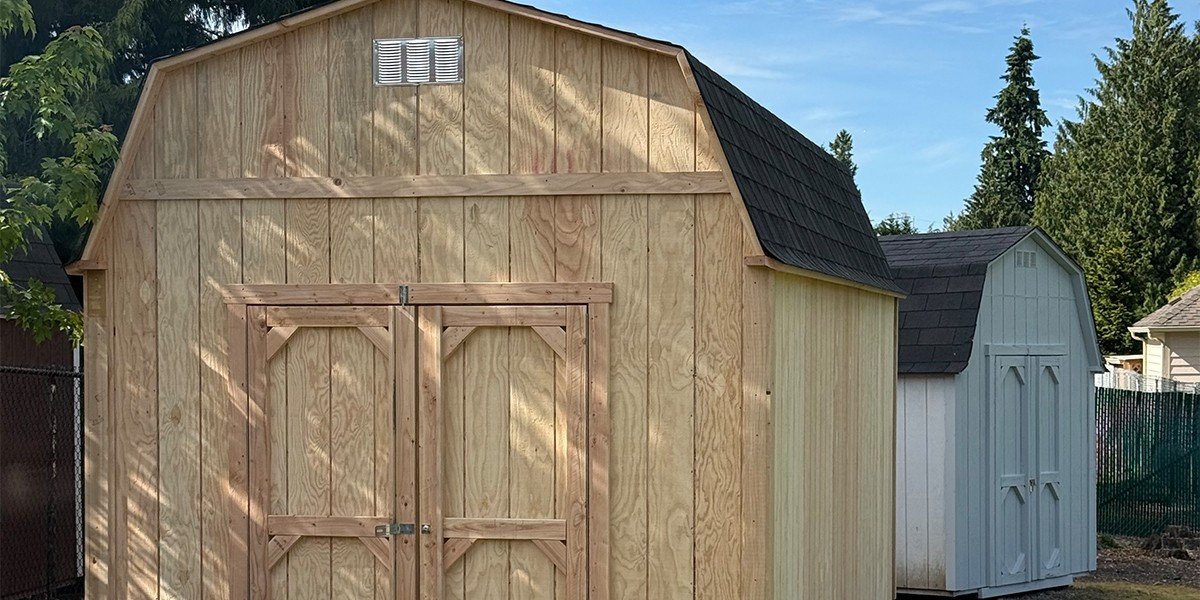
When you\’re evaluating custom wood storage sheds in Seattle, the choice isn\’t just about aesthetics—it\’s about engineering a structure that survives decades of Pacific Northwest weather while fitting your property\’s unique constraints. We\’ve built sheds throughout King County since 1993, and the performance gap between custom on-site construction and mass-market alternatives becomes clear within the first winter. Custom wood storage sheds in Kent and surrounding areas require specific material choices, moisture management systems, and foundation approaches that prefabricated units simply can\’t accommodate.
The Material Science Behind Douglas-Fir Performance
Most homeowners don\’t realize that lumber species selection determines whether your shed lasts 10 years or 40. We exclusively use locally sourced Douglas-fir for every custom wood storage shed we build, and the reasoning is structural, not aesthetic.
Douglas-fir demonstrates superior strength-to-weight ratios compared to the pine or fir blends used in manufactured sheds. More critically, it maintains dimensional stability in high-moisture environments. When relative humidity fluctuates between 40% and 90%—standard conditions in Seattle and Kent from October through May—Douglas-fir resists the warping and cupping that compromises door alignment, creates gaps in siding, and eventually leads to water infiltration.
The natural resin content in Douglas-fir also provides inherent decay resistance. While this doesn\’t eliminate the need for pressure-treated foundation components, it extends the service life of above-grade framing, siding, and roof structures that experience periodic moisture exposure but don\’t warrant the cost or appearance of fully treated lumber.
Why On-Site Construction Solves Seattle\’s Property Constraints
Seattle and Kent properties present access challenges that make prefabricated delivery impractical or impossible. We regularly navigate 36-inch side gates, sloped terrain with 15-degree grades, and properties where the ideal shed location sits 150 feet from the nearest vehicle access point.
Custom wood storage sheds built on-site eliminate these constraints entirely. We transport materials in manageable loads, assemble the structure in position, and achieve precise leveling that accounts for your property\’s specific drainage patterns and soil composition. This approach also allows real-time problem solving when we encounter unexpected conditions like buried utility lines, root systems, or drainage issues that would require expensive modifications to a pre-built unit.
The customization extends beyond placement. Need a shed that\’s 11 feet wide instead of 10 or 12? Standard prefab dimensions won\’t work. Require an offset door placement to accommodate existing landscaping? Impossible with factory configurations. Want integrated shelving positioned at specific heights for your gardening equipment? Not available in catalog options.
Engineering for King County\’s Moisture Reality
The biggest performance failure we see in imported sheds involves inadequate moisture management. King County receives 35-45 inches of annual precipitation depending on microclimate, with extended periods where structures never fully dry between rain events.
Our custom wood storage sheds incorporate multiple moisture defense layers. Pressure-treated skids with 40-year rot ratings create a foundation buffer between ground moisture and floor framing. We use CDX plywood rated for exterior exposure or T1-11 siding with proper flashing details at all penetrations. Roof overhangs extend 12-16 inches beyond wall lines, minimizing direct rain exposure on siding.
Ventilation design is equally critical. We position gable vents or ridge venting to create natural air circulation that prevents condensation accumulation on the interior surfaces. This isn\’t just about preventing mold—it\’s about protecting stored items from rust, corrosion, and moisture damage that renders tools and equipment unusable.
Floor systems in our sheds carry 400-pound-per-square-foot load ratings, accommodating the weight of wet soil bags, heavy equipment, and bulk storage without deflection that creates low spots where water can pool. Standard shed floors typically rate at 200-250 pounds per square foot, adequate for light storage but insufficient for serious gardening or equipment applications.
The Real Cost Analysis: Custom vs. Prefab
Price comparisons between custom wood storage sheds and big-box options often overlook the total cost of ownership. A $3,000 prefab shed that requires foundation work, delivery charges, assembly labor, and replacement within 8-10 years costs more than a $5,500 custom shed that lasts 30-40 years with minimal maintenance.
Consider the hidden costs in prefab options. Most require a prepared foundation—either a concrete slab or gravel base with precise leveling—adding $800-1,500 to the project. Delivery fees for King County range from $200-500 depending on distance. If you\’re not comfortable with assembly, contractor labor adds another $500-1,200. You\’re approaching custom pricing before accounting for the performance gap.
Custom wood storage sheds in Kent and Seattle also provide resale value that prefab units don\’t. Real estate agents consistently report that quality outbuildings contribute to property appeal and perceived value, particularly when they match the home\’s architectural style and demonstrate professional construction quality.
Design Flexibility That Matches Your Actual Needs
Every property has unique storage requirements, and catalog configurations force compromises. We\’ve built custom sheds with ceiling heights adjusted for riding mowers, door widths sized for specific equipment, and interior layouts organized around the client\’s workflow.
Common customizations include loft storage for seasonal items, built-in workbench areas with dedicated electrical circuits, specialized shelving for garden chemicals that keeps them secure and organized, ramp systems for wheeled equipment, and window placement that provides natural light without compromising security or wall space.
The advantage of custom work shows up in details like door swing direction optimized for your property\’s traffic flow, roof pitch that matches your home\’s style, and exterior finishes that coordinate with existing structures. These aren\’t cosmetic preferences—they\’re functional decisions that affect how well the shed integrates into your daily routine.
Installation Timeline and Site Impact
Concerns about construction disruption are common, but our installation process minimizes impact. Most custom wood storage sheds are completed in 3-8 hours regardless of size or customization level. We arrive with materials staged, complete the build, and clean the site before we leave.
Compare this to DIY assembly of a prefab shed, which typically requires 12-20 hours spread across multiple days, often with multiple people. Factor in the learning curve, tool requirements, and frustration level, and on-site professional construction becomes the efficient choice.
Regional Expertise That Shows in Performance
Thirty years of building in King County has taught us which construction details matter for long-term performance. We know that sheds in Maple Valley need different drainage considerations than those in Shoreline. We understand how wind patterns in Kent affect roof design differently than in Seattle\’s hill neighborhoods. We\’ve seen which fastener specifications prevent rust failure and which siding orientations minimize UV degradation on south-facing walls.
This accumulated knowledge doesn\’t exist in corporate design offices creating sheds for national distribution. It comes from building structures, observing their performance through multiple weather cycles, and continuously refining our methods based on real-world results.
Common General Questions
[sp_easyaccordion id=\”1909\”]
We\’ve spent three decades refining our approach to custom wood storage sheds throughout King County, and the underlying principle remains constant: structures built specifically for Pacific Northwest conditions using regionally appropriate materials will always outperform mass-market alternatives designed for generic national distribution. The difference shows up immediately in construction quality and becomes more apparent with each passing season.